In 2015, economists Anne Case and Angus Deaton published a landmark paper documenting rising mortality among middle-aged White non-Hispanic Americans driven by overdose, suicide, and alcoholic liver disease: the so-called "deaths of despair." The paper became a touchstone for understanding working-class White America's health crisis. What it did not include was Native American mortality data.
A subsequent analysis by Friedman, Hansen and Gone (2023) found that Native American deaths had been systematically excluded from the original framework, not just as an oversight but as an outcome of persistent racial misclassification on death certificates. This replication study uses CDC WONDER data to examine how the "deaths of despair" narrative changes, or collapses, when Native American and Alaska Native (AI/AN) mortality is included.
The data
Four causes of death were analyzed using CDC WONDER mortality microdata covering adults aged 45–54 from 1999 to 2019, filtered to exclude COVID-affected 2020 data. The dataset covers five racial and ethnic groups across all cause, overdose, suicide, and alcoholic liver disease mortality, disaggregated by Hispanic origin.
Key findings
When AI/AN data is included, the "White deaths of despair" narrative changes fundamentally. For alcoholic liver disease, AI/AN rates reach 75 per 100,000 by 2015–2019, compressing every other group, including White Americans, to the bottom of the chart.
Each cause of death tells a different story once AI/AN data is restored:
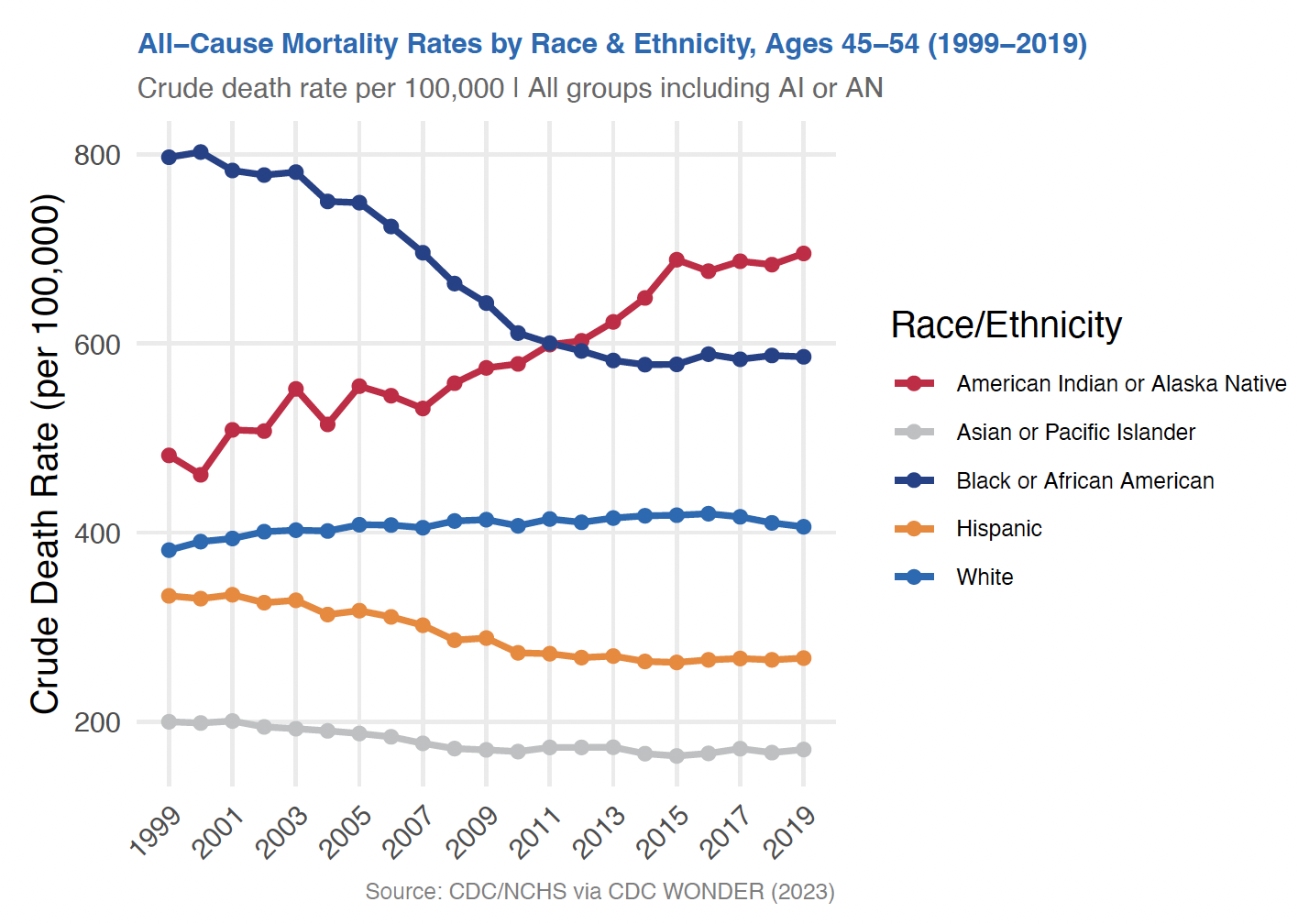
All-cause mortality by race and ethnicity (1999–2019). AI/AN (red) crosses Black or African American (dark blue) around 2011 and rises to become the highest mortality group by 2019, reaching approximately 700 per 100,000.
The contrast is sharpest for alcoholic liver disease. Without AI/AN, White rising mortality looks like the central story. With AI/AN included, White rates are barely distinguishable from Hispanic and Black rates, all three compressed to the bottom while AI/AN towers above them all.
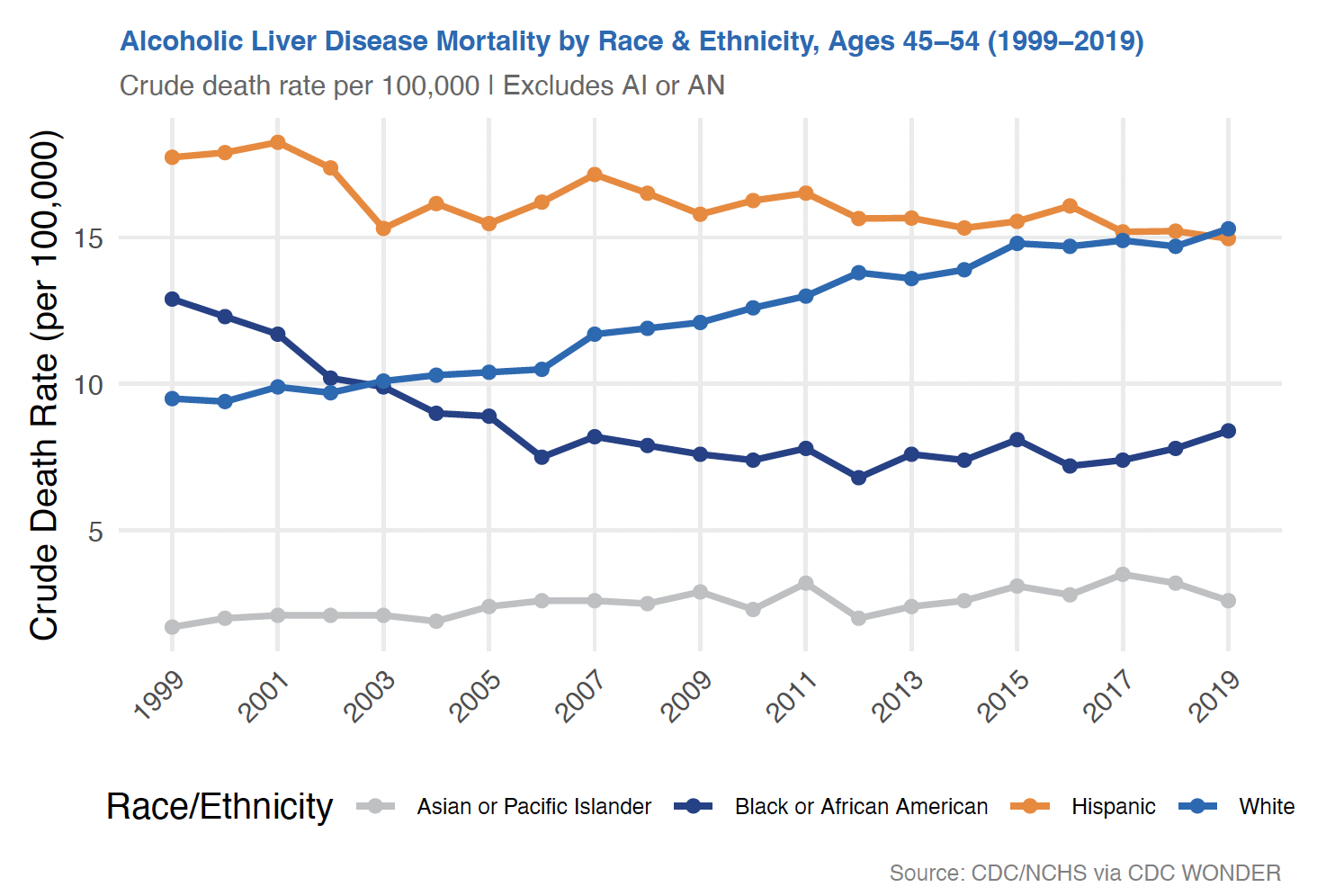
Alcoholic liver disease mortality excluding AI/AN (1999–2019). Without Native American data, White mortality rising from 10 to 15 per 100,000 appears to be the defining trend, consistent with the Case-Deaton "deaths of despair" narrative.
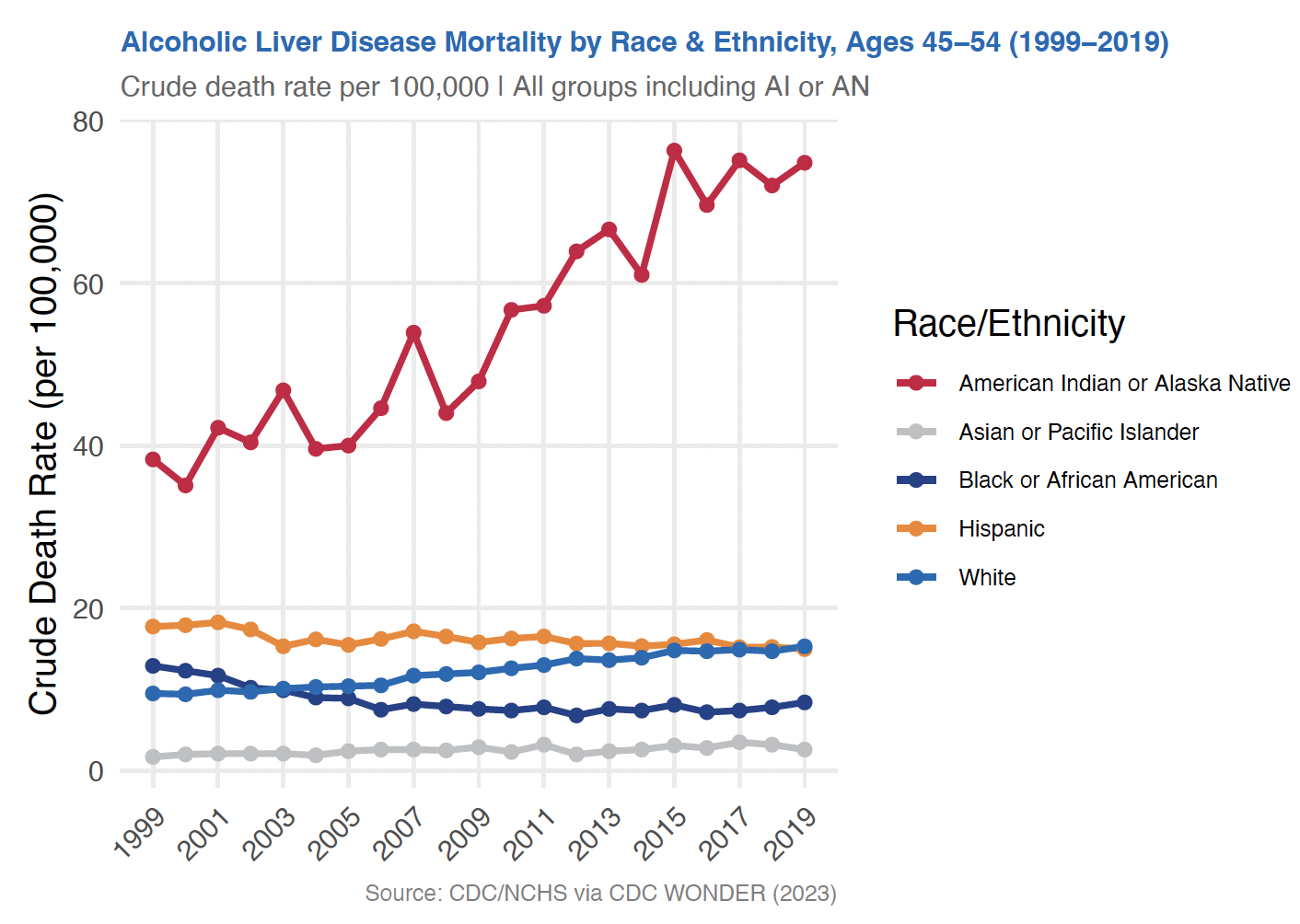
The same chart with AI/AN included. AI/AN rates reach 75 per 100,000 by 2015–2019, compressing every other group to the bottom. The White narrative collapses.
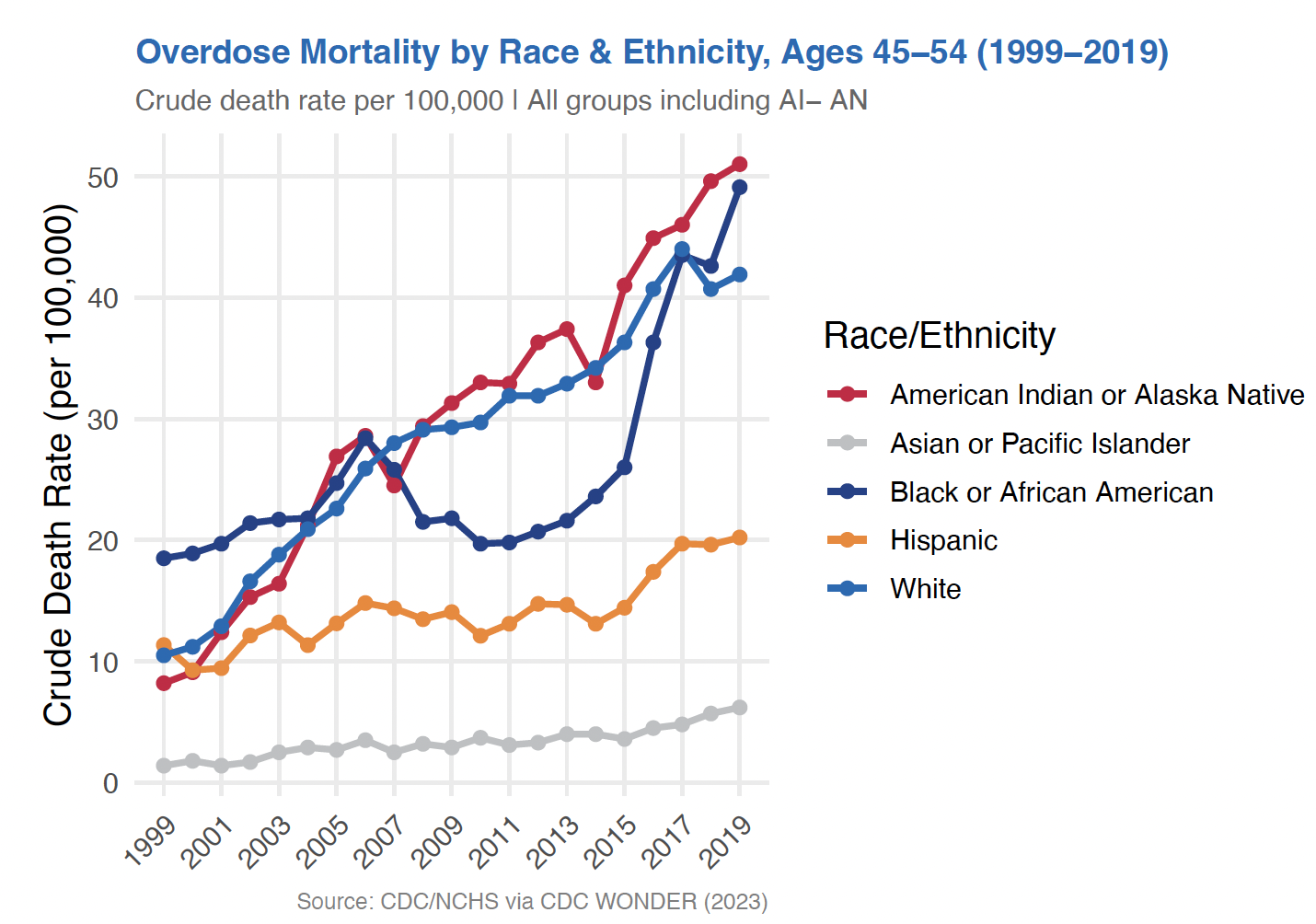
Overdose mortality by race and ethnicity (1999–2019, including AI/AN). AI/AN, White, and Black rates converge at the top by 2019, suggesting the fentanyl crisis is increasingly a multiracial crisis rather than a uniquely White one.
Suicide is the one cause where the White trend remains dominant even with AI/AN included: White rates are roughly 3 times higher than all other groups and rise steadily throughout the period. AI/AN rates sit firmly in second place but with high volatility, likely reflecting small population denominators and persistent undercounting in vital statistics.
What exclusion does to data
The misclassification of Native American deaths on death certificates is not a neutral data quality issue. It is the downstream effect of a long history of government-sanctioned erasure: from boarding school trauma and forced displacement to systematic destruction of Indigenous communities. When mortality data excludes or undercounts a population, it shapes which crises get named, which communities get resources, and which histories get told.
The volatility in AI/AN suicide and overdose trends is itself meaningful: unstable rates reflect small, undercounted denominators, which are themselves a product of the same erasure. The pattern is self-reinforcing: misclassification shrinks the apparent population, shrinking the population makes rates appear more volatile, and volatile rates are easier to dismiss as unreliable.
Policy implications
An inclusive analysis of Native American mortality requires more than adding a data series. It requires disaggregating AI/AN data by geography (reservation communities are systematically more underserved) and by tribal nation, rather than collapsing hundreds of distinct nations into a single category. It requires situating elevated mortality rates within the history of colonization rather than treating them as purely medical phenomena. And it requires investing in the data infrastructure to make Native American communities visible in national health surveillance.
Data-driven health policy that excludes the communities with the highest need is not neutral. It actively perpetuates the inequities it claims to address.