On November 4, 2025, New Yorkers elected 33-year-old democratic socialist Zohran Mamdani as their next mayor. His victory raises compelling questions: how did a young democratic socialist win New York City's highest office? What resonated with voters? Mamdani built his campaign around a singular vision: an affordable city, with housing at its core.
This project examines public discourse around the housing crisis during the last three years: what concerns and demands emerged from social media communities, and how media coverage framed the key actors and coalitions in this ongoing struggle for housing justice.
New York City has been experiencing a very acute housing crisis for several years, primarily the result of an inability to build sufficient housing generally, and sufficient affordable housing in particular. Key dimensions of the crisis include:
Using YouTube's API, I collected comments from videos covering NYC's housing crisis and Zohran Mamdani's platform. Sentiment analysis was conducted using VADER (Valence Aware Dictionary and sEntiment Reasoner), with adjusted thresholds and custom domain-specific vocabulary to better capture the tone of housing-related discourse.
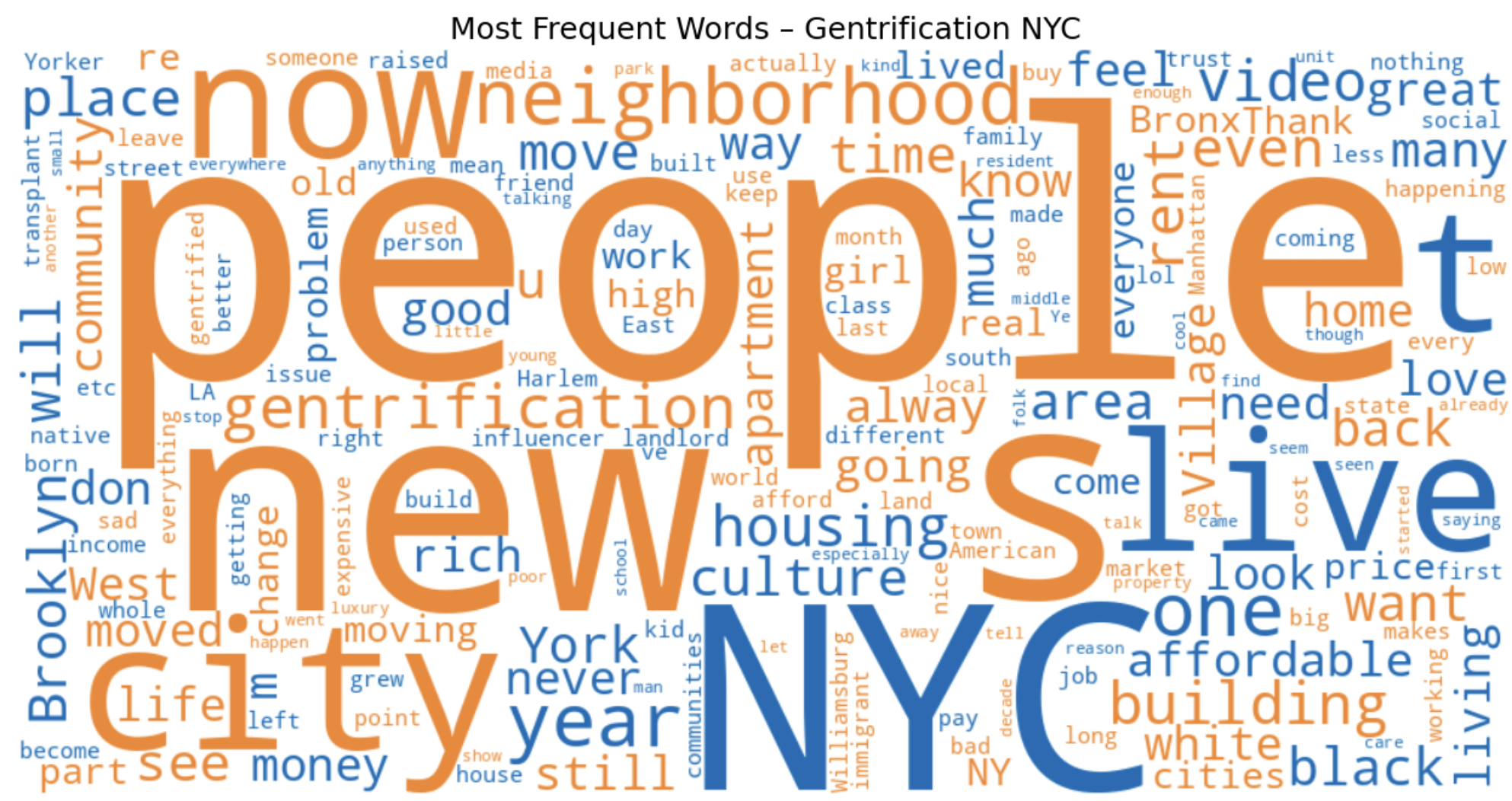
I also generated word clouds to visualize the most frequently used terms in the comments, filtering common stopwords to surface the language New Yorkers actually use when discussing housing.
Most frequent words in YouTube comments about gentrification in NYC. "People," "neighborhood," "city," and "news" dominate, alongside terms like "affordable," "community," and "displacement."
Most reactions to housing-related content were negative or neutral, with VADER requiring threshold adjustments and custom vocabulary to accurately classify the specific language of housing justice discourse.
To understand how mainstream media frames the housing crisis, I ran spaCy's Named Entity Recognition (NER) on a corpus of Factiva news articles (one article per row) to extract mentions of people, organizations, and locations. From these co-mentions, I built a person-to-person co-mention network to reveal which actors are consistently linked in media coverage of the housing debate.
The network analysis highlights prominent figures from the Democratic Party: Joe Biden, Kamala Harris, Eric Adams, Kathy Hochul, Chuck Schumer, Hakeem Jeffries, Alexandria Ocasio-Cortez, and Letitia James, as well as Republicans like Donald Trump and Curtis Sliwa. It also includes New York political leaders who frequently appear across party lines, such as Andrew Cuomo and Zohran Mamdani.
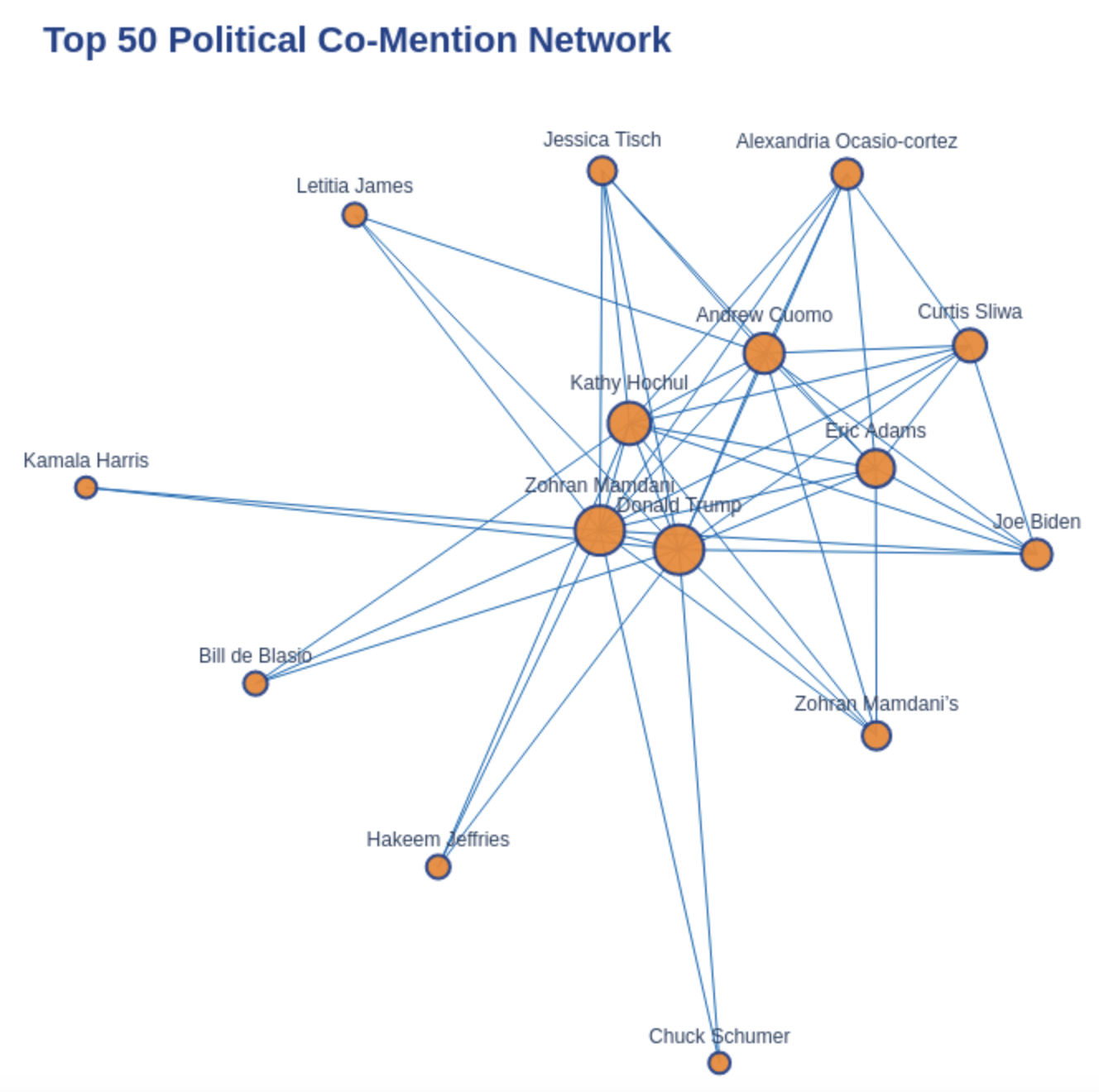
Top 50 Political Co-Mention Network. Node size reflects centrality; Donald Trump and Zohran Mamdani are the most connected actors in media coverage of NYC's housing crisis.
The connections in the network reflect how media tends to link these actors together when reporting on housing and gentrification in New York City. In the context of public policy, this suggests that these individuals are perceived as key stakeholders whose actions and positions shape the housing debate.
The city's neighborhoods are constantly evolving, but the current wave of change is marked by unprecedented rent increases, upscale development in formerly overlooked areas, and heightened risk of displacement for low- and middle-income New Yorkers. At the same time, resistance has grown, from local residents who successfully pushed back against large-scale development to elected officials pushing for stronger tenant rights.
In a city as dynamic as New York, the challenge moving forward will be balancing growth and investment with inclusivity and equity, ensuring that longtime New Yorkers can remain and thrive in the communities they built, even as those communities change.
View full project on GitHub ↗